The Best Cybersecurity Companies for Banks in 2026

Quick answer: The cybersecurity companies banks most often evaluate for branch, ATM, and building devices in 2026 include Asimily, Forescout, Ordr, Armis, Axonius, Claroty, Microsoft Defender for IoT, Fortinet, and Palo Alto Networks. Asimily fits banks that need one normalized inventory across every branch, priorities based on exploitability, and isolation from the cardholder data environment that is simulated before it is enforced. Forescout fits banks that want their own NAC, and Armis fits ServiceNow-centric teams.
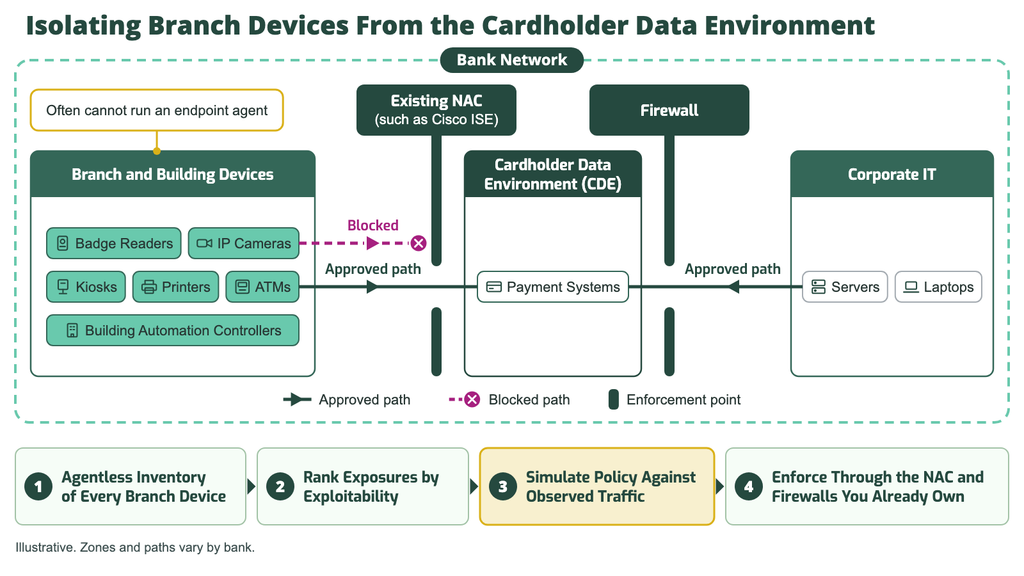
A bank security team must protect far more connected devices than its IT inventory usually lists, without disrupting branches, ATMs, or payment systems. Connected equipment such as ATMs, kiosks, IP cameras, badge readers, building automation controllers, and printers often share networks with corporate IT. These devices typically cannot run an endpoint agent and often sit near the cardholder data environment, which must be strictly segregated. Furthermore, any device missing from the inventory is automatically excluded from scope reviews and segmentation tests.
A good security partner for that environment finds every asset, including the devices IT does not track. It then highlights which exposures an attacker could actually exploit on your network while keeping the cardholder data environment isolated from all other assets.
This guide covers the criteria that separate bank-ready platforms from general security tools. It also provides a side-by-side view of the companies that appear most often in bank evaluations and explains where each one fits. It covers the connected devices around a bank, such as ATMs, kiosks, cameras, and building systems; endpoint, email, and fraud tools such as CrowdStrike are outside its scope. Asimily publishes this guide and includes itself in the analysis. Our descriptions draw on public positioning, technical approaches, and our own market research and conversations. Please take this into account and perform your own independent assessment.
The Best Cybersecurity Companies for Banks at a Glance
Asimily appears first as the publisher; the order of the other companies is not a ranking.
| Company | Primary Approach | Best Fit For |
|---|---|---|
| Asimily | Agentless visibility with normalized asset inventory data, exploitability analysis that separates risk from severity, and microsegmentation via Segmentation Orchestration with Policy Simulation across IoT, OT, and IT, plus Configuration Control to snapshot known good states. | Banks that need to move from a unified, normalized device inventory to enforced isolation of branch and building devices without disrupting service |
| Forescout | Device discovery, classification, and network access control across IT, OT, and IoT | Banks that want visibility and network access control from one vendor, independent of their switch vendor’s platform |
| Ordr | AI-driven device profiling and least-privilege policy across converged IT and OT | Converged networks that take a segmentation-first approach and want AI-assisted policy applied through existing firewalls, switches, and NACs |
| Armis | Agentless asset intelligence and exposure management across IT, OT, IoT, and cloud | Banks standardized on ServiceNow workflows |
| Axonius | Asset aggregation from existing IT, security, cloud, and SaaS tools into one inventory | IT-led teams building an asset register from data they already hold |
| Claroty | Cyber-physical systems protection: asset management, exposure management, network protection, secure access, and threat detection | Banks that need secure remote access for vendors |
| Microsoft Defender for IoT | Agentless network sensors for OT and IoT monitoring | Banks with large existing investments in Microsoft security tools |
| Fortinet | Firewalls and secure networking with OT protocol support | Banks consolidating network and security on one vendor |
| Palo Alto Networks | Next-generation firewalls, OT security services, and XDR across IT and OT | Banks extending an existing Palo Alto deployment to branches and building systems |
What to Look for in a Cybersecurity Company for Banks
Bank networks break assumptions that most security tools are built on: ATMs and other devices can’t take agents, branches are spread across many locations, and a blocked connection can take a branch or payment path offline. Use these six criteria to test whether a platform was built for the devices around a bank:
1. Visibility Into Branch, ATM, and Building Devices
- Agentless Discovery: Discovers ATMs, kiosks, IP cameras, badge readers, building automation controllers, and printers captured agentlessly into a unified inventory with normalized data across live operations.
- Multi-Branch Topology: Provides clear network topology across hundreds of branch locations using appropriately sized sensors to avoid unnecessary costs at smaller sites.
- Unified Asset Coverage: Normalizes IoT and IT assets that may share the same network to prevent unmonitored bridges into the cardholder data environment.
2. Prioritization by Exploitability Using Likelihood and Business Impact
- Contextual Exploitability: Determines whether a vulnerability is actually exploitable on a specific device in your topology, going beyond generic CVSS base scores.
- Business Impact Focus: Prioritizes risk reduction while protecting payment systems and service continuity across branch operations.
- Actionable Output: Delivers a clear, ranked list of mitigation steps organized by maximum risk reduction benefit.
3. Isolation You Can Prove Before You Deploy
- Native Policy Integration: Generates policies in native formats for existing tools like NACs (e.g., Cisco ISE) and firewalls to overcome segmentation project stalls.
- Traffic Previews: Simulates policy impact against real, observed traffic to prevent unexpected disruptions before enforcement.
- No Re-Addressing: Avoids risky re-IP projects for branch devices and ATMs by working directly on existing network infrastructure.
4. Mitigation for Devices You Can’t Patch
- Compensating Controls: Recommends targeted mitigations (e.g., disabling unused services, updating default credentials, microsegmentation) when legacy devices cannot be patched.
- Selective Patching: Shrinks overall attack surface by identifying and updating devices that can safely receive firmware updates, such as supported IP cameras.
5. Continuous Monitoring and Forensic Evidence
- Configuration Drift Detection: Monitors for unexpected configuration changes that could compromise existing segmentation designs.
- Targeted Packet Capture: Provides native packet capture for specific branch or ATM assets during anomalous behavior to speed incident investigation.
6. Audit and Examiner Evidence on Demand
- Regulatory Alignment: Supports continuous compliance across frameworks including PCI DSS, the Gramm-Leach-Bliley Act (GLBA), NYDFS 23 NYCRR 500.13, DORA, and FFIEC/NIST CSF 2.0.
- Continuous Audit Records: Maintains an automated, audit-ready record of enforced controls, asset inventories, and changes on demand.
The Best Cybersecurity Companies for Banks in 2026
1. Asimily
Asimily is an asset protection platform covering IoT, OT, middleware, AI agents, servers, and endpoints. For banks, it unifies ATMs, kiosks, cameras, badge readers, and building systems into one normalized inventory to pinpoint risk and isolate devices from the cardholder data environment.
Discovery is agentless, combining passive network analysis with safe queries. ATT&CK Analysis measures compromise likelihood based on segmentation, patching, and context to separate risk from severity.
Segmentation Orchestration simulates and applies policy through existing NACs and firewalls, preserving device IPs. Asimily has no switch-level enforcement of its own. Configuration Control detects drift, while native packet capture speeds investigations. Additionally, Risk Simulator models mitigation impact, and IoT Patching updates firmware and passwords on supported devices.
Recognition: 2026 Merit Awards winner, rated 4.9/5 on Gartner Peer Insights (55 reviews, Oct 2026).*
*Gartner Peer Insights content consists of the opinions of individual end users based on their own experiences, and should not be construed as statements of fact, nor does it represent the views of Gartner or its affiliates. Gartner does not endorse any vendor, product, or service depicted in this content, nor does it make any warranties, expressed or implied, with respect to this content, about its accuracy or completeness, including any warranties of merchantability or fitness for a particular purpose.
Best fit for: Banks needing a unified, normalized asset inventory across every branch, exploitability-based priorities, and isolation validated before enforcement.
What to evaluate: Discovery at one of your branches, the documented reason behind each prioritized device, and Policy Simulation against your own traffic.
2. Forescout
Forescout discovers and classifies devices across IT, OT, and IoT and pairs that visibility with policy enforcement and automated response, building on its network access control heritage. Its platform was renamed Forescout Vistaro in June 2026 (Forescout).
Best fit for: Banks that want device visibility and access control from one vendor, including branch networks without a NAC, independent of their switch vendor’s platform.
What to evaluate: How the platform previews the impact of an enforcement action on a branch or ATM network before it is applied.
3. Ordr
Ordr’s AI Protect platform profiles devices by function, behavior, and communication patterns across converged IT and OT networks, and generates least-privilege policy that an analyst approves before it is applied through existing firewalls, NACs, switches, and wireless controllers.
Best fit for: Banks with converged networks that want AI-assisted policy creation and a segmentation-first approach for devices that cannot run agents.
What to evaluate: How vulnerabilities are prioritized by exploitability on your devices, and which mitigation options exist beyond segmentation.
4. Armis
Armis Centrix is an agentless asset intelligence and exposure management platform spanning IT, OT, IoT, and cloud. ServiceNow completed its acquisition of Armis in April 2026 (Verdict), and Armis Centrix remains available as a standalone product.
Best fit for: Banks that run IT and security workflows in ServiceNow and want device risk and remediation inside those workflows.
What to evaluate: How deeply it classifies branch and building devices, and whether segmentation policy can be created, simulated, and maintained from the same platform.
5. Axonius
Axonius Asset Cloud aggregates asset data from existing IT, security, cloud, and SaaS tools through more than 1,400 adapters, correlating devices, software, identities, and exposures into one inventory. Remediation runs mainly through tickets and the tools already in place. Axonius has also announced Cyber-Physical Assets, a product that fingerprints OT and IoT devices (SiliconANGLE, April 2026).
Best fit for: IT-led teams that need to reconcile assets already held in IT, cloud, and SaaS tools into an asset register.
What to evaluate: The availability and depth of device fingerprinting for ATMs and building systems, and how remediation moves beyond tickets to enforced controls.
6. Claroty
Claroty focuses on cyber-physical systems across industrial, healthcare, and commercial environments. Its platform covers asset management, exposure management, network protection, secure remote access, and threat detection, and the company reports deployments at more than 8,000 sites across 40 industries.
Best fit for: Banks whose building and facilities systems fall in scope and need secure remote access for third-party technicians.
What to evaluate: How much of the platform applies to branch and ATM devices, and how network protection recommendations become enforced policy on your existing NAC and firewalls.
7. Microsoft Defender for IoT
Microsoft Defender for IoT uses agentless network sensors to monitor OT and IoT devices (Microsoft Learn). It is most often considered by organizations that already invest heavily in Microsoft security tools.
Best fit for: Banks with large existing investments in Microsoft security tools.
What to evaluate: How findings are prioritized by exploitability on your specific devices, and what the platform does after an alert to reduce exposure.
8. Fortinet
Fortinet’s Security Fabric combines firewalls, secure networking, endpoint protection, and centralized management, with OT protocol support and ruggedized hardware for remote facilities.
Best fit for: Banks consolidating networking and security on a single vendor.
What to evaluate: Which system will supply the device context and risk priorities that decide your firewall rules.
9. Palo Alto Networks
Palo Alto Networks extends its next-generation firewalls, segmentation, and Cortex XDR into OT environments to limit lateral movement between enterprise and operational networks, and documents device policy recommendations through its IoT Security service (Palo Alto Networks).
Best fit for: Banks extending an existing Palo Alto deployment from the data center to branches and building systems.
What to evaluate: Visibility into unmanaged branch and ATM devices, and how segmentation rules are validated against branch traffic before rollout.
Other Companies Banks Consider
Cisco, CrowdStrike, Tenable, Dragos, Nozomi Networks, TXOne Networks, and Darktrace also appear in bank evaluations. Cisco is widespread for switch infrastructure across all industries. CrowdStrike is usually evaluated for endpoint protection on managed devices rather than ATMs or building systems. Tenable is usually considered by teams that want device inventory inside an existing Tenable vulnerability management program, and Darktrace as an extension of an existing IT security investment. Dragos, Nozomi Networks, and TXOne Networks are often seen as OT specialists that matter mainly where a bank runs industrial control systems. Teams that need staff augmentation more than a platform often pair one of the companies above with a managed security provider.
Choosing the Right Fit for Your Bank
- Visibility and Cost Efficiency: Teams lacking full visibility into branch devices (ATMs, cameras) should test discovery first and verify per-branch sensor pricing.
- Policy Simulation and Enforcement: Teams needing enforcement should evaluate whether the platform can simulate and maintain policy across existing firewalls and NACs without requiring new access control hardware.
- Compliance and Examiner Proof: Teams preparing for audits should verify how quickly and accurately the platform produces normalized inventory and isolation evidence.
- Stakeholder Pilot Validation: Always run pilots using live operational traffic and involve branch operations and payment systems teams before applying changes.
[Related: OT Security: A Complete Guide to Protecting Operational Technology]
[Related: The Best Critical Infrastructure Cybersecurity Companies in 2026]
[Related: Best IoT Security Platforms 2026 Rankings]
Frequently Asked Questions About Cybersecurity Companies for Banks
What Is the Best Cybersecurity Company for Banks?
The best fit depends on your program’s maturity. If all a bank needs is basic device visibility, most platforms on this list will provide it. If it is also important to have prioritization based on real exploitability rather than severity scores, and segmentation that is simulated against observed traffic before it is enforced, Asimily covers all three in one platform with unified asset normalization. Forescout, Ordr, and Armis focus on device visibility and policy, and Fortinet and Palo Alto Networks extend network security into multi-site branches. Asimily excels at providing strong, normalized asset inventory data across IoT, OT, and IT using multiple methods, including AI, deep packet inspection, and its database of well over 10,000,000 observed devices and profiles.
How Does PCI DSS Affect Branch and ATM Devices?
PCI DSS asks entities to confirm the scope of their cardholder data environment at least every 12 months and after significant changes, along with regular testing (PCI Security Standards Council). ATMs, cameras, badge readers, and building systems that share a network with that environment, or can connect to it, are generally in scope unless segmentation isolates them, and segmentation controls must be tested at least every 12 months, or every six months for service providers. Network changes between tests can quietly reconnect devices that were isolated. Requirements vary, so confirm current rules with your compliance team and assessor.
How Do Banks Isolate Branch Devices From the Cardholder Data Environment Without Disruption?
They start with the highest-risk devices, validate each policy against real, observed traffic before it is applied, and roll changes out in stages, so branch and payments owners see exactly which devices and connections would be affected. Asimily’s Policy Simulation does this, and Continuous Segmentation keeps the NAC policies that Asimily manages current as matching devices are added or stop matching. Many banks still schedule major network changes for planned maintenance windows, and a long enough simulation can give owners the confidence to switch a policy to enforcement sooner, reducing risk exposure windows.
What Do NYDFS and DORA Require for Asset Inventory?
Section 500.13 of NYDFS 23 NYCRR Part 500 asks covered entities for written procedures to create and maintain an inventory of information systems, with final requirements effective November 1, 2025. The Digital Operational Resilience Act (DORA), a European Union regulation applicable since January 17, 2025, requires EU financial institutions to identify, classify, and document all Information and Communication Technology (ICT) assets (which include hardware, software, network systems, and digital data) and their operational dependencies. Applicability varies by institution and regulator.
How Is Device Security Different From IT Security at a Bank?
Traditional IT security relies on endpoint agents and routine patching. Many ATMs, cameras, badge readers, and building controllers can’t run agents or accept routine patches, so protection depends on agentless visibility, compensating controls such as segmentation, and changes that are validated before they reach branches. The consequences differ too: a compromised camera or controller on a flat branch network can become a path toward payment systems.
See How Asimily Protects Banks
Asimily gives banks one unified, normalized asset inventory across IoT, OT, and IT, a short list of the exposures that are actually exploitable, and isolation policy simulated against real traffic before it is enforced.


Secure Every IoT Device.
Automatically.
Cyber threats move fast — so should you. Asimily gives instant inventory and smart, prioritized risk mitigation insights for every IoT, OT, and IoMT device — so you can take action before threats strike.